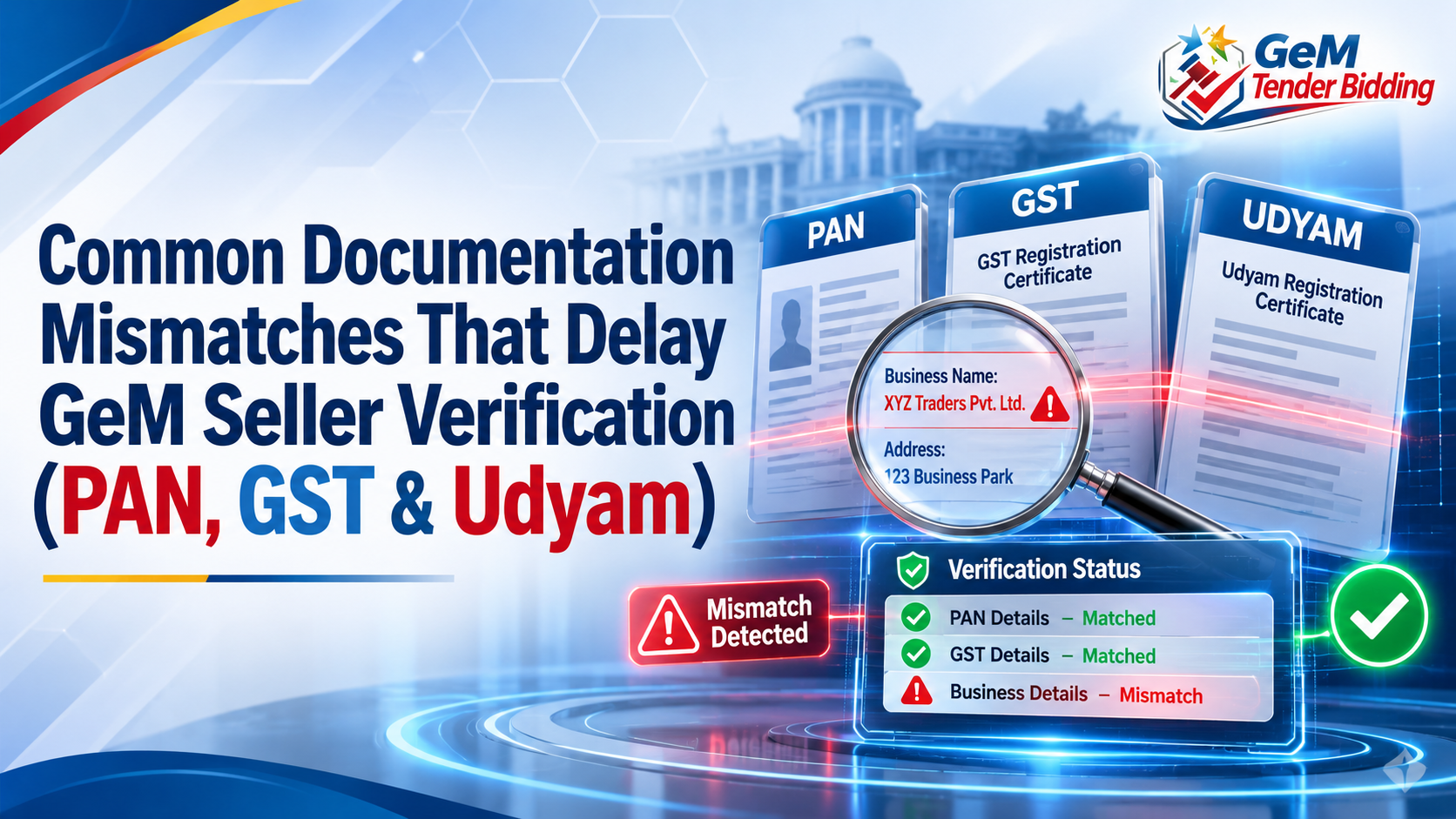
Many GeM sellers wrongly believe that GeM’s MSE preference and L1 + 15% process offers them a ‘fast track’ to successful government buying. Often there is confusion regarding what exactly constitutes price parity; how volume is distributed; and which businesses can claim MSE preference within a tender. Understanding the MSE preference process on GeM allows MSMEs to accurately price their tenders. Here are some of the key misconceptions, alongside a description of how MSE preference is applied. Myth 1 – Price parity in the L1+15% range automatically results in you receiving orders at that price. Myth: Your tender quotation is within the 15% range (for example, L1 = 1,00,000 and your quotation is 1,12,000), therefore you will automatically receive orders at this price. Reality: Being within L1+15% does not automatically mean that you will receive orders at your quoted price. Rather, it enables qualifying MSEs to attempt to achieve price parity with L1 (providing that this is permitted by the tender documentation). Should you be unable/ unwilling to do so then you cannot expect to receive orders purely for being within the L1+15% range. Myth 2 – All MSMEs (Including Traders and medium enterprises) benefit from MSE preference. Myth: All MSMEs have preference in all GeM tenders. Reality: Only Micro and Small enterprises are eligible for MSE preference. Medium enterprises are not included in MSE purchasing preference. Furthermore, for physical products, the usual case is that the manufacturer is subject to MSE preference rather than those solely involved in trading and/or re-selling, unless tender documentation indicates that this should not be the case. Always refer to the relevant tender documentation to determine whether MSE preference is available for your business and product/service type. Myth 3 – Price parity within the L1+15% range ensures full order receipt. Myth: Providing you are able to achieve price parity with L1, and are within the L1+15% range, you will receive the whole order. Reality: Volume distribution is dependant upon tender design and procurement processes. Usually, qualifying MSEs in the L1+15% range who are able to achieve price parity with L1 can be allocated part of an order (for example, typically up to 25% as per standard MSE policy provisions or proportionally if there are several qualifying MSEs who can achieve price parity with L1). The remainder of the volume is allocated in line with the tender assessment criteria. Where the product is not divisible, or the tender states that only one recipient is to be identified, then volume is allocated in accordance with the tender provision. Myth 4 – MSE preference operates even if the L1 bidder is also an MSE. Myth: Where the L1 bidder is also an MSE, the L1+15% price parity process still takes place for other bidders. Reality: The purpose of the L1+15% price parity process is to enable qualifying MSEs to participate in the tender should the L1 bidder is not themselves an MSE. Typically, where the L1 bidder is also a qualifying MSE, then the L1+15% price parity process for non-L1 bidders does not operate in the same manner. Myth 5 – Solely possessing a Udyam certificate is sufficient. Myth: Provided that your business has a Udyam registration then you can claim preference and will successfully pass validation. Reality: In addition to having a Udyam registration, your Udyam information should correspond with your live business profile. As well as this, your business still needs to fulfil the technical, eligibility and validation requirements set out within the tender. Departments/buyers validate that businesses both technically comply with, and are capable of fulfilling, tenders at the required price prior to making an award decision. Ensure that your business is well prepared prior to submitting a low quotation in an effort to gain/maintain L1 price parity. Refer to Common Documentation Discrepancies Which Cause GeM Seller Validation Delays (covering PAN, GST and Udyam) to avoid issues relating to your business profile and validation. Brief illustration of how L1+15% operates: Within a GeM tender, imagine that the L1 price has been quoted by a non-MSE business at 1,00,000. L1+15% maximum price = 1,15,000. Bidder X (MSE) quotes 1,10,000. They are within the L1+15% range and can therefore be asked to attempt to achieve price parity with L1. Should Bidder X do this (i.e. quote 1,00,000), then they can be allocated a portion of the order in line with tender provisions for qualifying MSEs. Bidder Y (MSE) quotes 1,22,000. They are outside of the L1+15% range and are thus not eligible to participate in the L1+15% price parity process. Even where price parity with L1 is permitted, never price tenders so low that you would suffer a financial loss when including freight, packing, taxation and delivery expenses. Essential Pre-Validation Checks for MSE Preference • Establish whether your business is Micro or Small in nature (not Medium). • Ascertain whether MSE preference is permitted for your particular product/service in the relevant tender. • Ensure that your business and related documentation is current and correct. • Analyse your true landed cost (incorporating delivery, taxation and compliance expenses) and do not agree to price parity with L1 unless you are confident that you can sustainably provide at this price. Conclusion Whilst MSE preference can be a useful feature within GeM, it is important that you thoroughly examine tender documentation and price your tenders based on genuine costs. Undertaking pre-validation procedures ensures that you save time and avoid accepting unviable orders. For further information and assistance in relation to GeM tendering, visit our GeM Bidding Support facility on Tender18.